 weboxacademy | Premium WordPress Assets, SEO Training & Educational Videos
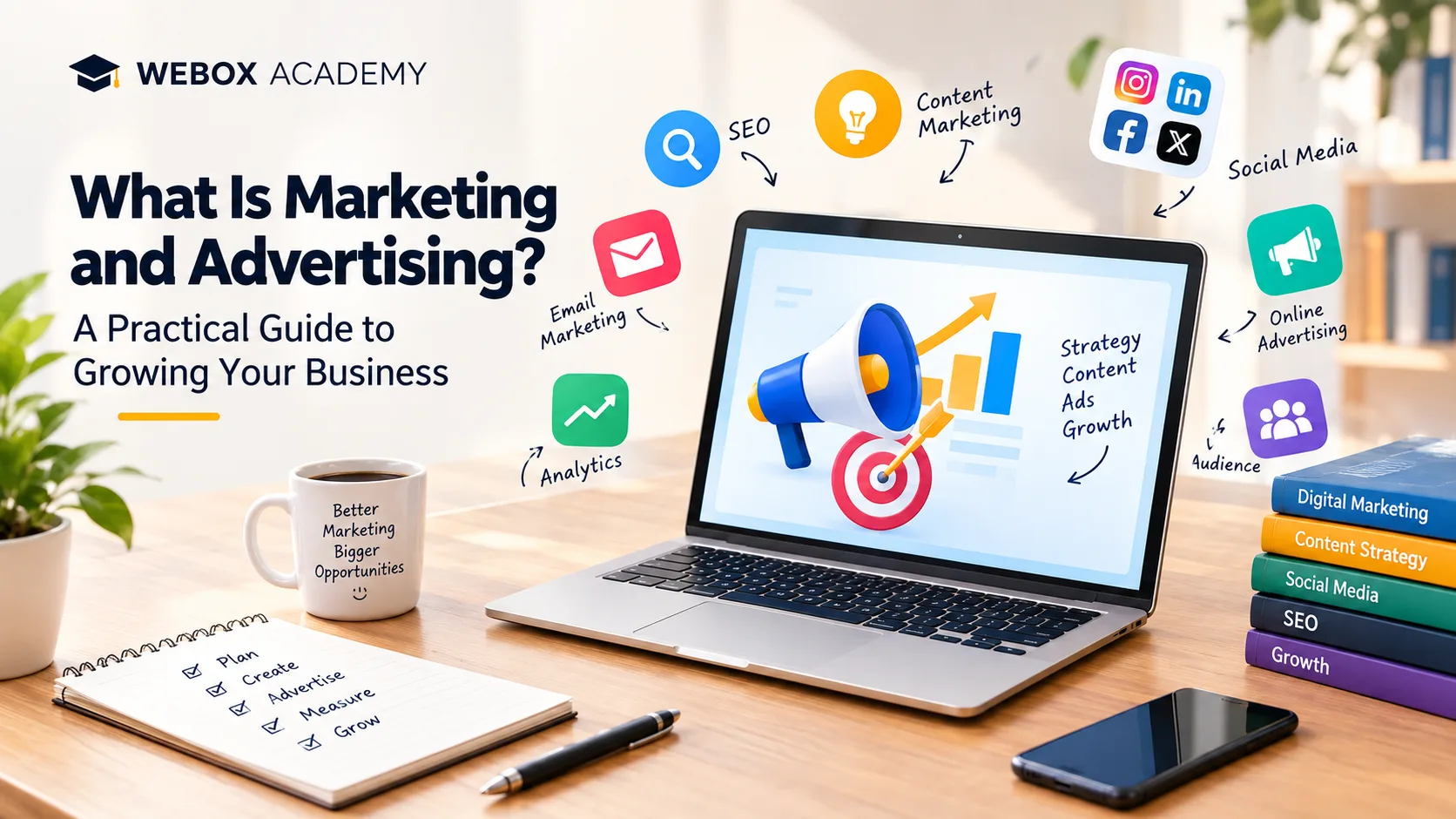
You can have an excellent product, but if nobody knows about it, generating meaningful sales can be difficult. This is where marketing and advertising become essential.
Marketing is much more than promoting a product. Understanding your audience, identifying their real needs, creating a compelling offer, producing useful content, appearing in search engines, building trust, and eventually turning visitors into customers are all parts of a successful marketing strategy.
The digital landscape has also changed the way businesses attract customers. Today, creating a banner and simply waiting for sales is not enough. Businesses need to understand who their customers are, where they spend their time, what they search for, and what stage of the buying journey they are in.
In this guide, we explore the fundamentals of marketing and advertising, including digital marketing, online advertising, content marketing, social media, SEO, marketing funnels, performance measurement, and the growing role of artificial intelligence.
What Is Marketing?
Marketing is the process of understanding a market, identifying customer needs, creating value, attracting potential customers, and building relationships that can lead to sales and long-term loyalty.
One common mistake is treating marketing and advertising as the same thing.

Advertising is only one part of marketing.
For example, imagine that you run an online shoe store.
Before advertising your products, you might research your target customers, find out what types of shoes they are looking for, understand their preferred price range, and determine where they usually shop.
That research is part of marketing.
You can then use different channels to reach those customers, including:
- Google Ads
- Social media advertising
- SEO
- Content marketing
- Email marketing
- Display advertising
- Influencer marketing
In simple terms:
Marketing determines what you should offer, who you should offer it to, and why they should care. Advertising is one of the ways you communicate that offer to your target audience.
What Is Advertising?
Advertising is the process of promoting a product, service, brand, or message through a specific communication channel.
Advertising can have different objectives, such as:
- Introducing a new brand
- Increasing sales
- Generating leads
- Promoting a product
- Building brand awareness
- Driving website traffic
- Reaching new customers
- Bringing previous customers back
Traditional advertising methods such as television, billboards, magazines, and print media can still be useful for certain businesses.
However, digital advertising gives businesses more opportunities to target specific audiences and measure campaign performance.
What Is Digital Marketing?
Digital marketing refers to marketing activities carried out through digital channels and platforms.
Websites, search engines, social media platforms, email, mobile applications, and online advertising networks are some of the most important digital marketing channels.
One of the biggest advantages of digital marketing is measurability.
Instead of simply knowing that an advertisement was seen, you can track things such as:
- How many people clicked the ad
- How many visitors reached your website
- How many people submitted a form
- How many visitors made a purchase
- How much you spent to acquire each customer
- Which campaign generated the most revenue
This information allows businesses to make better decisions about their marketing budget.
The Most Important Digital Marketing Strategies
Digital marketing is not a single strategy. It is a combination of different channels and techniques that can work together as part of a larger marketing system.
1. SEO and Search Marketing
Search engine optimization (SEO) is one of the most important ways to attract organic traffic from search engines.
SEO focuses on improving web pages so they can appear more prominently for relevant searches.
For example, someone searching for “best laptop for programming” may have a much stronger purchase intent than someone simply reading a general article about laptops.
This is why successful SEO is not just about choosing keywords.
Search intent, content quality, website structure, user experience, authority, and how effectively a page answers the user’s question all matter.
Search behavior is also becoming increasingly conversational. Users are asking longer and more specific questions, while AI-powered search experiences are changing how people discover information.
This makes useful, well-structured, accurate, and genuinely helpful content more important than ever.
2. Content Marketing
Content marketing involves creating and distributing useful content that provides real value to a target audience.
Content can take many forms, including:
- Blog posts
- Videos
- Podcasts
- Tutorials
- Buying guides
- Infographics
- Case studies
- Social media content
However, content marketing is not simply about publishing as many articles as possible.
Every piece of content should have a purpose.
For example, a blog post might be designed to:
- Attract organic search traffic
- Answer a customer’s question
- Build trust
- Introduce a product
- Generate leads
- Support a sales decision
The goal is not to create more content.
The goal is to create better content with a clear purpose.
3. Pay-Per-Click Advertising
Pay-per-click (PPC) advertising is a digital advertising model where advertisers generally pay when someone clicks on their advertisement.
Google Ads is one of the best-known examples of PPC advertising.
One major advantage of PPC is speed.
Unlike SEO, which usually requires time to build organic visibility, a well-structured advertising campaign can start bringing targeted visitors to a website relatively quickly.
However, getting clicks does not automatically mean getting sales.
If the keyword, advertisement, landing page, offer, or checkout experience is poor, a campaign can generate many clicks without producing enough customers.
This is why businesses should evaluate advertising based on conversions, revenue, and profitability—not clicks alone.
4. Social Media Marketing
Social media has become an important point of contact between brands and their audiences.
However, an effective social media strategy should not consist entirely of promotional posts.
Educational content, short-form videos, customer experiences, behind-the-scenes content, product demonstrations, entertaining posts, and answers to common customer questions can all play a role.
Video has also become an increasingly important part of the customer journey, particularly short-form video content.
The objective is not simply to gain followers.
The real goal is to build attention, trust, engagement, and eventually meaningful business results.
What Is a Marketing Funnel?
A marketing funnel represents the different stages a potential customer can move through before and after making a purchase.
Not everyone who sees your advertisement is ready to buy.
Someone may be discovering your brand for the first time, while another person may have spent several days researching your product. Someone else may already be ready to purchase.
A simplified marketing funnel can look like this:
Awareness → Interest → Consideration → Decision → Purchase → Loyalty
Each stage requires a different approach.
For example, educational content may work better for someone who has never heard of your brand.
On the other hand, a customer who has already visited your product page several times may respond better to a strong offer, comparison, demonstration, or purchase incentive.
Understanding where a customer is in the funnel helps you deliver the right message at the right time.
Why Is Knowing Your Audience Important?
One of the most common marketing mistakes is trying to sell a product to everyone.
In reality, every product has a more suitable target audience.
Before launching a marketing campaign, you should be able to answer questions such as:
Who is my ideal customer?
What problem are they trying to solve?
What are they searching for?
What prevents them from buying?
Why should they choose my business instead of a competitor?
The answers can influence everything from your advertising copy to your landing page and product positioning.
How Is Artificial Intelligence Changing Marketing?
Artificial intelligence is changing many parts of the marketing process, from research and brainstorming to data analysis and content personalization.
Marketers can use AI tools to help with tasks such as:
- Generating content ideas
- Creating advertising variations
- Analyzing campaign data
- Understanding audience segments
- Developing video ideas
- Researching competitors
- Creating different versions of marketing messages
- Summarizing customer feedback
However, using AI does not mean removing human expertise from the process.
Content that is mass-produced by AI without original insights, experience, or useful information can easily become similar to thousands of other pages online.
A stronger approach is to combine:
AI + Human Expertise + Real Data + Original Insights
This combination can make marketing faster while keeping the final result useful and authentic.
What Are Marketing KPIs?
If you do not measure your marketing performance, it becomes difficult to know which activities are actually contributing to business growth.
Some important marketing KPIs include:
- Click-through rate (CTR)
- Conversion rate
- Customer acquisition cost (CAC)
- Number of leads
- Cost per lead
- Revenue
- Return on ad spend (ROAS)
- Customer lifetime value (CLV)
- Customer retention rate
For example, Campaign A may generate more clicks than Campaign B, but Campaign B might generate more paying customers.
Therefore, the campaign with the most clicks is not necessarily the most successful campaign.
More Advertising or Better Marketing?
When sales decline, some businesses immediately increase their advertising budget.
But more advertising is not always the solution.
The real problem could be somewhere else:
Product → Offer → Advertisement → Landing Page → Trust → Checkout
If your product page is confusing or unconvincing, increasing your advertising budget may simply send more visitors to the same weak page.
If your offer is not attractive enough, improving the advertisement alone may not solve the problem.
Before increasing your budget, it is often better to examine the entire customer journey.
A Simple Digital Marketing Strategy for Beginners
If you are just starting with digital marketing, you do not need to be active on every channel at once.
A practical approach can look like this:
Step 1: Understand the Market
Research your target audience, competitors, customer needs, and market demand.
Step 2: Define Your Goal
Decide what you actually want to achieve.
Is your goal to increase sales, generate leads, build brand awareness, or increase website traffic?
Step 3: Choose the Right Channels
Choose marketing channels based on where your target audience spends time and how they make purchasing decisions.
Step 4: Create a Strong Offer
Give your audience a clear reason to pay attention, learn more, sign up, or buy.
Step 5: Launch Your Campaign
Use the appropriate combination of SEO, content, paid advertising, email, or social media.
Step 6: Measure the Results
Track the KPIs that matter to your business.
Step 7: Optimize
Identify what works, improve what does not, and invest more in the strategies that generate meaningful results.
This process should be repeated continuously.
Common Marketing and Advertising Mistakes
Several common mistakes can waste a significant amount of time and money.
Advertising Without Understanding the Audience
If you do not know who you are targeting, your messaging and targeting are likely to be weak.
Focusing Only on Traffic
High traffic is not necessarily valuable if those visitors do not contribute to your business goals.
Creating Content Without a Strategy
Publishing large amounts of content without a clear purpose does not automatically lead to more customers or better rankings.
Ignoring the Landing Page
Even an excellent advertisement can fail if the visitor lands on a confusing, slow, or unconvincing page.
Not Measuring Performance
Without reliable data, marketing decisions often become guesses.
The Future of Marketing and Advertising
Digital marketing continues to evolve rapidly.
Artificial intelligence, conversational search, video, personalization, automation, and new advertising platforms are changing how people discover brands and make purchasing decisions.
Because of this, successful marketers need more than knowledge of a single tool.
They need to understand how audience behavior, data, content, technology, and different marketing channels work together.
The boundaries between marketing, SEO, content creation, advertising, analytics, and artificial intelligence are becoming increasingly connected.
Businesses that learn how to combine these areas strategically will be better positioned to adapt to the changing digital landscape.
Final Thoughts
Marketing and advertising are about much more than paying to display an advertisement.
Successful marketing starts with understanding the audience, continues with a strong offer and the right message, and relies on appropriate channels, valuable content, targeted advertising, and continuous measurement.
When these elements work together, advertising stops being simply an expense.
It becomes part of a measurable system for attracting customers, increasing sales, and building sustainable business growth.
At Weboxacademy, you can explore more practical guides about digital marketing, SEO, online advertising, content marketing, social media, artificial intelligence, and other skills needed to grow in the modern digital economy.