 weboxacademy | Premium WordPress Assets, SEO Training & Educational Videos

Search engine optimization is one of the most valuable skills in digital marketing. Businesses rely on SEO to increase organic visibility, attract qualified visitors, generate leads, and build long-term online authority. However, learning SEO effectively requires more than reading a few blog posts or watching random tutorials.
A well-structured SEO training course should provide a clear learning path, explain how search engines work, introduce essential tools, and give learners enough practical experience to apply their knowledge to real websites. It should also reflect the latest changes in search, including artificial intelligence, generative search experiences, content quality, technical performance, and user intent.
Whether you are a complete beginner, a website owner, a content creator, a marketing professional, or someone planning to start an SEO career, choosing the right course can make a significant difference. The best SEO courses do not focus only on rankings or keywords. They teach learners how to understand search behavior, optimize websites, create useful content, measure performance, and adapt to changes in the search ecosystem.
In this guide, we will explain what a complete SEO training course should include and what you should look for before enrolling in one.
Why Is SEO Training Important?
SEO can appear simple at first. You may hear that improving rankings mainly involves using keywords, publishing content, and building backlinks. Although these activities are part of SEO, professional optimization is much more comprehensive.
SEO includes technical website performance, content quality, search intent, internal linking, user experience, structured data, analytics, authority building, and ongoing building, and ongoing in one area can affect the performance of the entire website.

Structured SEO training helps learners:
- Understand how search engines discover and rank content
- Perform effective keyword research
- Identify the search intent behind keywords
- Optimize website pages and blog content
- Find and fix technical SEO problems
- Build a logical internal linking structure
- Improve website speed and mobile usability
- Analyze competitors and search results
- Measure organic traffic and conversions
- Develop content strategies based on real data
- Understand AI SEO and emerging search experiences
- Apply SEO techniques to real projects
Instead of learning disconnected tactics, students can develop a complete understanding of how different SEO activities work together.
What Should a Complete SEO Training Course Include?
A comprehensive SEO training course should cover both fundamental concepts and practical implementation. The following topics are essential for anyone who wants to build reliable SEO skills.
1. SEO Fundamentals
Every effective SEO training program should begin with the basics. Students need to understand the purpose of SEO before learning advanced techniques.
An introductory SEO module should explain:
- What search engine optimization means
- How search engines work
- Crawling and indexing
- Search engine results pages
- Organic and paid search
- Ranking factors
- Search intent
- White-hat and black-hat SEO
- The relationship between SEO and digital marketing
Search engines use automated systems to discover, process, and organize information from websites. Crawlers visit pages, search engines analyze their content, and indexed pages may appear in search results when they are relevant to a user’s query.
However, ranking is not based on one single factor. Search engines evaluate many signals, including relevance, content quality, website accessibility, page experience, authority, and the usefulness of the result for the searcher.
A beginner-friendly course should explain these concepts in a simple and practical way. Without a strong foundation, learners may rely on outdated techniques or misunderstand why a page is ranking.
2. Keyword Research and Search Intent
Keyword research is one of the core subjects every SEO training course should teach. It helps marketers understand what people search for, how they phrase their questions, and what type of content they expect to find.
A complete keyword research module should cover:
- Short-tail and long-tail keywords
- Search volume
- Keyword difficulty
- Search intent
- Commercial keywords
- Informational keywords
- Navigational keywords
- Transactional keywords
- Related searches
- Question-based keywords
- Competitor keyword analysis
- Keyword mapping
Search volume alone should not determine whether a keyword is valuable. A keyword with a high search volume may be extremely competitive or too broad to generate relevant traffic. In contrast, a specific long-tail keyword may attract fewer visitors but produce better engagement and more conversions.
Search intent is equally important. A person searching for “what is SEO” probably wants an educational explanation. Someone searching for “best SEO training course” may be comparing different learning options. A user searching for “buy SEO course” has a stronger commercial or transactional intent.
A Google appears to should teach learners how to analyze the search results for a keyword and identify the content format Google appears to prefer. Depending on the query, the results may include blog articles, product pages, service pages, videos, comparison guides, or local business listings.
If you want to develop a deeper understanding of modern SEO, you can explore our complete SEO Masterclass, which covers essential search optimization concepts together with AI SEO and GEO topics.

3. On-Page SEO
On-page SEO refers to optimizing the visible and structural elements of a webpage. It helps search engines understand the topic of a page and helps users find and consume information more easily.
A complete SEO training course should explain how to optimize:
- SEO titles
- Meta descriptions
- H1 and subheadings
- URL structure
- Main content
- Keyword placement
- Image file names
- Image alt text
- Internal links
- External references
- Content readability
- Calls to action
- Structured data
SEO titles should clearly describe the page and encourage users to click. Meta descriptions do not directly guarantee higher rankings, but a clear and relevant description can improve the likelihood of receiving clicks from search results.
Headings help organize content into logical sections. A page should usually have one clear H1 heading, followed by relevant H2 and H3 headings. This structure improves readability and makes it easier for search engines to understand the relationship between different topics.
On-page SEO should never be reduced to repeating a keyword as many times as possible. Excessive repetition can make content unnatural and may create a poor user experience. Instead, the focus should be on covering the topic thoroughly, answering user questions, and using related terminology naturally.
4. Content SEO and Content Strategy
Content is one of the most important parts of any SEO strategy. However, publishing content regularly does not automatically produce results. A strong content strategy should be based on audience needs, search intent, content strategy
- content quality.
A professional SEO training program should teach:
- How to create a content strategy
- How to build topic clusters
- How to prepare content briefs
- How to match content with search intent
- How to structure long-form articles
- How to identify content gaps
- How to update old content
- How to improve content originality
- How to demonstrate expertise and trust
- How to create content for different stages of the buyer journey
A useful article should provide more than a basic definition. It should answer important questions, explain concepts clearly, include practical examples, and help the reader take action.
For example, an article about SEO training should not only define SEO education. It should explain what students should learn, how to compare courses, which tools matter, and how practical experience affects professional development.
Content training should also include editorial planning. Learners should understand how to create a publishing calendar, organize topics, avoid keyword cannibalization, and connect related pages through internal links.
A course should also introduce the importance of originality and human review when using AI tools. Artificial intelligence can support research, outlining, and content workflows, but high-quality content still requires accuracy, expertise, editing, and a clear understanding of the audience.
5. Technical SEO
Technical SEO helps search engines access, interpret, and index a website. It also affects user experience and website performance.
A complete SEO training course should include the following technical topics:
- Website crawlability
- Indexability
- XML sitemaps
- Robots.txt
- Canonical URLs
- Redirects
- Broken links
- Duplicate content
- HTTPS
- Mobile optimization
- Page speed
- Core Web Vitals
- Website architecture
- JavaScript SEO
- Pagination
- International SEO signals
- Structured data
Technical problems may prevent important pages from appearing in search results. For example, a page may be accidentally blocked by robots.txt, marked as noindex, or excluded because of an incorrect canonical tag.
Website architecture is another important topic. A clear structure helps users and search engines navigate the website. Important pages should not be buried several levels deep, and related content should be connected through logical navigation and internal links.
Page speed and mobile performance should also be included in technical SEO training. Users expect websites to load quickly, especially on mobile devices. Slow pages can increase frustration, reduce engagement, and affect the overall quality of the user experience.
An effective course should not only define technical SEO concepts. It should show students how to perform an audit, interpret reports, prioritize issues, and verify whether a technical fix has worked.
6. Internal Linking
Internal linking is often overlooked by beginners, but it is a valuable part of website optimization. Internal links connect pages on the same website and help users discover related information.
A good internal linking strategy can:
- Improve website navigation
- Distribute authority between pages
- Help search engines discover content
- Establish topical relationships
- Support important commercial pages
- Encourage users to visit additional pages
- Improve the overall content structure
An SEO training course should teach learners how to choose relevant pages, write descriptive anchor text, identify orphan pages, and avoid excessive or irrelevant links.
For example, an article about choosing an SEO course could naturally link to a course page using anchor text such as:
- Complete SEO Masterclass
- practical SEO training course
- AI SEO and GEO course
- modern search optimization training
- learn SEO through practical video lessons
Anchor text should describe the destination page accurately. It should feel natural within the sentence rather than appearing forced for search engines.
Internal linking should also reflect the website’s content hierarchy. Informational blog posts may link to relevant service or product pages, while broader pillar pages may link to more specific supporting articles.
7. Link Building and Off-Page SEO
Link building is another important topic that should be included in professional SEO training. External links from relevant and trustworthy websites can help strengthen a website’s authority and visibility.
A complete off-page SEO module should cover:
- What backlinks are
- Why link relevance matters
- Link authority
- Digital PR
- Guest posting
- Outreach campaigns
- Resource page links
- Industry directories
- Brand mentions
- Competitor backlink analysis
- Linkable assets
- Toxic or manipulative links
- Link-building risks
Students should understand that not every backlink has the same value. A relevant link from a respected website may be more useful than many unrelated links from low-quality sources.
A sustainable link-building strategy begins with creating assets that deserve attention. These may include original research, detailed guides, useful tools, expert interviews, data studies, or visual resources.
Outreach should be personalized and relevant. Sending the same generic message to hundreds of websites is unlikely to produce strong results. A better approach is to identify websites whose audiences would genuinely benefit from the resource.
SEO training should also explain the difference between ethical promotion and manipulative practices. Paid or artificial link schemes, irrelevant link exchanges, automated links, and low-quality networks can create long-term risks.
The goal of link building should not be to collect as many links as possible. The goal should be to increase visibility, build relationships, earn mentions, and attract qualified referral traffic.
8. Local SEO
If a course is designed for small businesses, agencies, freelancers, or local service providers, it should include local SEO.
Local SEO training should explain:
- Google Business Profile
- Local search intent
- Local keyword research
- NAP consistency
- Local citations
- Customer reviews
- Local landing pages
- Location-based content
to compete visibility
- Local link building
- Service-area businesses
A local business may not need to compete for broad national keywords. It may achieve better results by targeting specific services and locations that reflect its actual market.
For example, a local training provider may target phrases related to SEO courses in a particular city, while an international online course may focus on broader search terms such as “SEO training course” or “learn technical SEO online.”
Learners should understand how local search results differ from traditional organic results and how location, relevance, prominence, and business information affect visibility.
9. E-commerce SEO
E-commerce SEO is another valuable specialization. Online stores have unique optimization requirements because they contain product pages, category pages, filters, variations, reviews, and transactional content.
A complete course may cover:
- Product keyword research
- Category page optimization
- Product descriptions
- Product schema
- Review markup
- Faceted navigation
- Out-of-stock pages
- Duplicate product content
- Internal linking for stores
- E-commerce analytics
- Conversion-focused SEO
Product pages should provide accurate, helpful information and make it easy for users to understand the product’s value. Category pages should be optimized for broader commercial terms and should help users navigate products efficiently.
Technical issues such as duplicate URLs, filter parameters, and crawlable faceted navigation can become particularly complex on large e-commerce websites.
10. SEO Analytics and Reporting
SEO is not complete without measurement. Learners need to know how to evaluate performance and communicate results.
A professional SEO training course should introduce:
- Google Search Console
- Google Analytics
- Keyword tracking tools
- Organic traffic analysis
- Impressions
- Click-through rate
- Average position
- Conversions
- Landing page performance
- Engagement metrics
- Referral traffic
- SEO reporting
Google Search Console can help website owners understand how their pages appear in search results. It provides information about queries, impressions, clicks, indexing, and technical issues.
Analytics tools can provide additional information about what visitors do after arriving on a website. For example, learners may analyze which landing pages generate leads, which traffic sources produce engagement, and where users leave the conversion process.
SEO reporting should focus on meaningful business outcomes rather than vanity metrics. Ranking for a keyword may be useful, but traffic quality, leads, sales, and qualified conversions often matter more.
Students should also learn how to establish a baseline, define key performance indicators, compare time periods, and explain progress clearly to clients or business owners.
11. SEO Tools and Workflows
SEO tools can make research, auditing, and reporting more efficient. However, tools should support strategic thinking rather than replace it.
Depending on the course level, students may learn to use:
- Google Search Console
- Google Analytics
- Google Keyword Planner
- Google Trends
- PageSpeed Insights
- Screaming Frog
- Ahrefs
- Semrush
- Rank Math
- Yoast SEO
- Looker Studio
- Browser-based SEO extensions
A high-quality course should explain not only what each tool does, but also when and why to use it.
For example, a crawling tool may help identify broken links, missing titles, duplicate metadata, or redirect problems. A keyword research platform may help compare search demand and competitors. A reporting tool may help present performance data in a clear format.
The best training programs also demonstrate repeatable workflows. Students should learn how to move from research to implementation, monitoring, reporting, and continuous improvement.

12. AI SEO
Modern SEO training should include a thoughtful introduction to AI SEO. Artificial intelligence is changing how marketers research topics, create briefs, analyze data, and manage repetitive tasks.
AI SEO may include:
- AI-assisted keyword research
- Search intent classification
- Content brief creation
- Topic expansion
- Competitor research
- Content optimization
- Internal link suggestions
- SEO workflow automation
- Data analysis
- Content quality review
However, AI-generated output should not be published without human evaluation. Automated content may contain factual errors, generic statements, missing context, or information that does not match the audience’s needs.
Learners should understand how to use AI responsibly. AI can make SEO workflows faster, but human expertise remains essential for strategy, originality, accuracy, brand voice, and editorial judgment.
A useful AI SEO module should teach students how to create effective prompts, verify information, improve generated drafts, and combine AI assistance with first-hand knowledge and reliable sources.
13. Generative Engine Optimization, or GEO
Generative Engine Optimization, commonly known as GEO, is an emerging area connected to AI-generated search experiences and answer engines.
A GEO module may explain how to make information easier for AI systems to understand, to, summarize, and accurately represent. Important principles include:
- Clear content structure
- Direct answers to user questions
- Strong topical relevance
- Reliable facts
- Author expertise
- Brand consistency
- Supporting evidence
- Well-organized headings
- Structured information
- Natural language
GEO should not be presented as a guaranteed method for appearing in every AI-generated answer. The field is developing, and search platforms may use different systems and signals.
The practical goal is to create content that is useful, trustworthy, well-structured, and easy to interpret across different search environments. These principles are also beneficial for traditional SEO because they improve clarity and user experience.
Your course title, SEO Masterclass: AI SEO, GEO & Complete Search Course, gives you a strong opportunity to connect traditional SEO fundamentals with the future of search. You can introduce it naturally in this section using anchor text such as AI SEO and GEO training.
14. Practical Projects and Real-World Exercises
Theory alone is not enough to become an effective SEO professional. Learners need opportunities to apply concepts to real websites and realistic situations.
A strong SEO training course should include projects such as:
- Keyword research for a website
- Search intent analysis
- Website SEO audit
- On-page optimization
- Technical SEO review
- Competitor analysis
- Content brief creation
- Internal linking strategy
- Backlink opportunity research
- Performance reporting
- AI-assisted SEO workflow
- Content optimization project
Practical assignments help students understand how different SEO activities connect. For example, a keyword research project can lead to a content brief, an optimized article, an internal linking plan, and a performance report.
Case studies are also useful because they demonstrate the reasoning behind SEO decisions. Students should learn how to identify a problem, evaluate possible solutions, implement changes, and measure the outcome.
When comparing courses, look for programs that include exercises rather than only recorded lectures. A video-based program can be highly effective when lessons are organized clearly and supported by practical examples.
Beginner SEO Training vs. Advanced SEO Training
Not every learner needs the same level of training. A beginner course should introduce essential concepts without overwhelming students with highly technical topics.
Beginner SEO Training Should Include:
-
SEO fundamentals
-
Keyword research
-
Search intent
-
Basic on-page SEO
-
Content optimization
-
Internal linking
-
Basic technical SEO
-
Introduction to SEO tools
-
Basic analytics
-
Enterprise
Advanced SEO Training May Include:
- Technical SEO audits
- JavaScript SEO
- Enterprise SEO
- International SEO
- E-commerce SEO
- Advanced schema implementation
- Log file analysis
- Large-scale content management
- Advanced link-building campaigns
- SEO automation
- Advanced analytics
- AI SEO workflows
- GEO and generative search
A good course should clearly state who it is designed for. Beginners need a structured introduction, while experienced marketers may prefer advanced strategies, audits, automation, and specialized case studies.
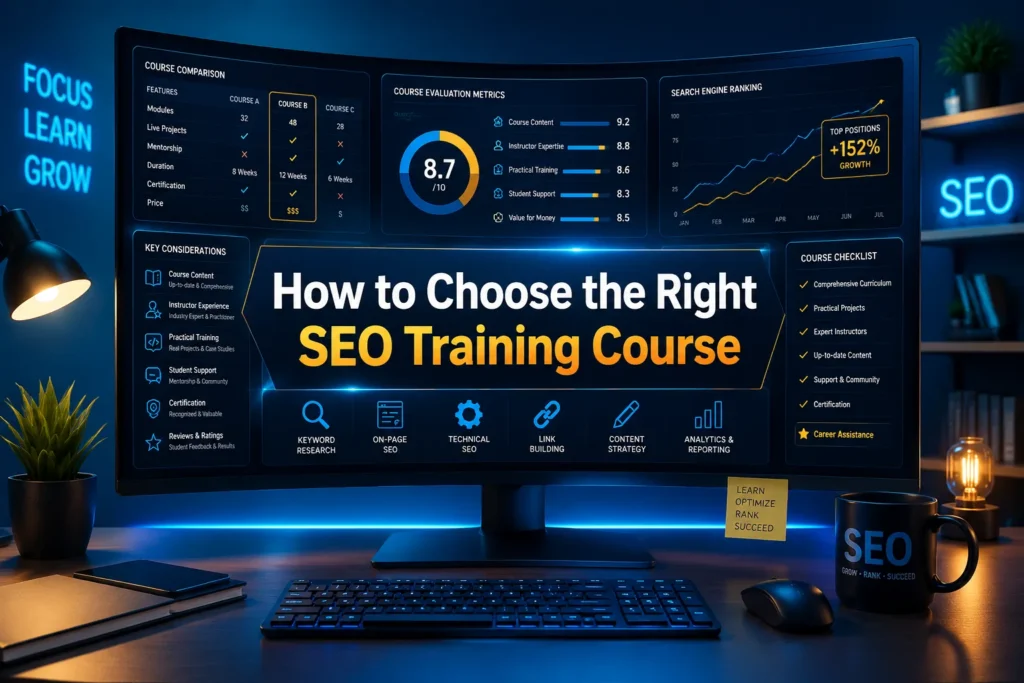
How to Choose the Right SEO Training Course
Before enrolling in an SEO course, evaluate its structure, content, instructor, and practical value.
Check the Course Curriculum
The curriculum should cover more than keywords and basic content optimization. Look for a balanced program that includes technical SEO, on-page SEO, content, analytics, link building, and current search developments.
Look for Practical Training
A course should give you opportunities to apply your knowledge. Practical assignments, audits, case studies, and projects are strong indicators of useful training.
Review the Instructor’s Experience
The instructor should understand how SEO works in real projects. Practical experience is particularly important for technical SEO, content strategy, analytics, and link building.
Make Sure the Content Is Current
SEO changes over time. A course should reflect current search practices, mobile optimization, content quality, structured data, artificial intelligence, and modern search behavior.
Consider the Learning Format
Video courses can be convenient because students can learn at their own pace. A well-organized video guide should have clear modules, logical lessons, practical demonstrations, and easy navigation.
Evaluate the Tools Included
The course should mention which tools are used and whether learners receive practical guidance. Tool names alone are not enough; students should learn how to interpret and apply the data.
Check Whether the Course Matches Your Goals
Your goals may include:
- Improving your own website
- Starting an SEO career
- Offering SEO services
- Growing an online business
- Creating better content
- Learning AI SEO
- Understanding GEO
- Building an SEO agency
The best course is the one that matches your current level and professional objectives.
Why a Complete Video-Based SEO Course Can Be Useful
A complete video course can provide a more organized learning experience than collecting information from unrelated sources.
The advantages may include:
- A structured learning path
- Flexible study times
- The ability to replay complex lessons
- Visual demonstrations
- Consistent terminology
- A complete overview of SEO
- Easier progress tracking
- Practical screen-based instruction
A 9-hour and 48-minute video guide can provide enough time to explain essential concepts in detail without forcing learners to search for missing information across multiple platforms.
However, course length should not be the only factor. The quality of explanations, practical examples, organization, and relevance of the lessons are equally important.
If you are looking for a structured program that combines traditional optimization with newer search concepts, you can explore the complete SEO Masterclass.
Common Mistakes When Learning SEO
Many beginners make avoidable mistakes because they focus on isolated tactics instead of understanding the complete process.
Common mistakes include:
Focusing Only on Keyword Density
Keywords are important, but repeating them excessively does not create useful content. Relevance, clarity, completeness, and search intent matter more.
Ignoring Technical SEO
A well-written article may struggle if search engines cannot crawl or index the page properly.
Building Low-Quality Backlinks
A large number of irrelevant or manipulative links may create risk instead of improving authority.
Publishing Without a Strategy
Content should be based on audience needs, keyword research, business goals, and a clear site structure.
Measuring Only Rankings
Rankings are useful, but traffic quality, engagement, leads, and conversions provide a more complete picture.
Trusting AI Without Reviewing the Output
AI tools can support SEO work, but all content should be checked for accuracy, originality, context, and brand alignment.
Expecting Immediate Results
SEO is usually a long-term process. Results depend on competition, website history, content quality, technical health, authority, and consistency.
Frequently Asked Questions About SEO Training
What is SEO training?
SEO training is a structured educational program that teaches learners how to improve website visibility in search engines, attract organic traffic, optimize content, analyze performance, and develop search marketing strategies.
What should an SEO training course include?
A complete course should include SEO fundamentals, keyword research, search intent, on-page SEO, technical SEO, content strategy, internal linking, link building, analytics, SEO tools, practical projects, AI SEO, and emerging areas such as GEO.
Is SEO training suitable for beginners?
Yes. Beginner-friendly SEO training should start with fundamental concepts and gradually introduce more advanced topics. Students do not need extensive technical knowledge to begin learning SEO.
How long does it take to learn SEO?
The basics of SEO can be learned within several weeks with consistent study and practice. Developing professional-level skills usually takes longer because SEO requires experience with different websites, industries, tools, and search environments.
Is practical experience important in SEO training?
Yes. Practical experience is essential. Audits, content optimization tasks, keyword research projects, and reporting exercises help learners understand how to apply theory to real websites.
Can I learn SEO through a video course?
Yes. A well-structured video course can be an effective way to learn SEO. Video lessons allow students to study at their own pace, review difficult topics, and follow practical demonstrations.
What is AI SEO?
AI SEO refers to the use of artificial intelligence to support SEO activities such as research, planning, content optimization, data analysis, and workflow automation. AI should support human expertise rather than replace strategic judgment and quality control.
What is GEO?
GEO stands for Generative Engine Optimization. It focuses on improving how a brand or piece of content may be understood and represented in AI-generated answers and generative search experiences.
Should an SEO course teach link building?
Yes. Link building and off-page SEO are important parts of a comprehensive SEO curriculum. However, the course should focus on relevant, ethical, and sustainable methods rather than manipulative link schemes.
Can SEO training help me start a career?
SEO training can help you build foundational and practical skills for roles such as SEO specialist, content strategist, digital marketing specialist, SEO consultant, or website optimizer. Building a portfolio and gaining practical experience can further improve your opportunities.
Conclusion
A complete SEO training course should offer much more than a basic explanation of keywords and rankings. It should teach learners how search engines work, how users search, how websites are structured, how content should be optimized, and how SEO performance can be measured.
The SEO
-
combine:
-
SEO fundamentals
-
Keyword research
-
Search intent
-
On-page SEO
-
Technical SEO
-
Content